Hidden Conflicts in Your Medicine Cabinet: How Supplements and Vitamins Can Quietly Undermine Your Fertility Medications
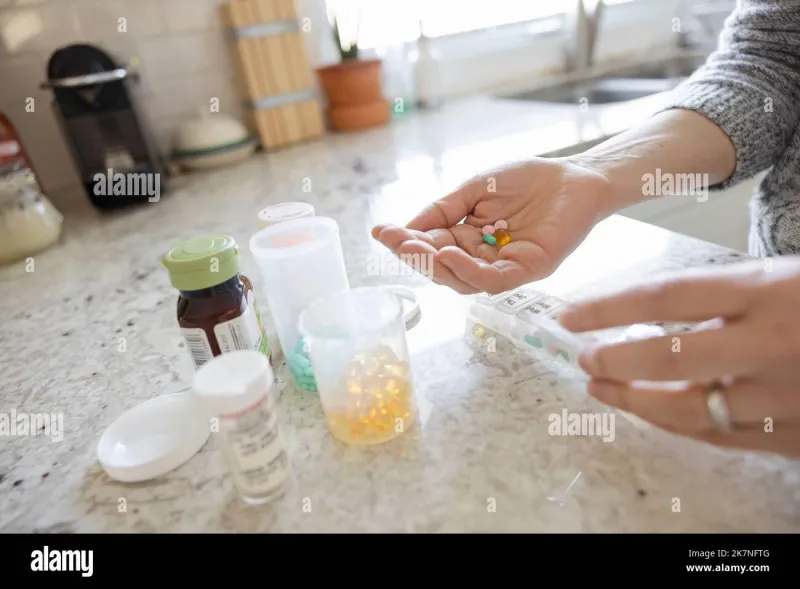
Photo: woman organizing supplements and prescription medications on kitchen counter, via c8.alamy.com
When a patient begins a fertility protocol, the conversation with their reproductive endocrinologist typically centers on the prescribed medications—Clomid dosing schedules, gonadotropin injection timing, trigger shot windows. What often receives far less attention is the collection of bottles already sitting on the bathroom shelf: the prenatal vitamin, the CoQ10 capsule, the adaptogenic herb a friend recommended, the melatonin taken nightly for sleep.
Each of those products can interact with fertility drugs in ways that range from mildly inconvenient to clinically significant. And because supplements are purchased over the counter and rarely appear in electronic medical records, they occupy a blind spot in what is already a complex prescribing environment. Understanding these interactions is not about abandoning supplements altogether—many have legitimate roles in a fertility-supportive routine—but about ensuring that every substance you take is part of an informed, coordinated plan.
Why the Supplement Blind Spot Exists
The structure of reproductive medicine creates conditions for siloed prescribing. A patient may see a primary care physician, an OB-GYN, a reproductive endocrinologist, and a naturopath—none of whom necessarily reviews a complete list of what the others have recommended. Supplements, perceived as "natural" and therefore benign, are frequently omitted from medication histories by patients and underasked by clinicians.
Pharmacists, who are often the most accessible resource for drug interaction screening, can only flag conflicts they know about. If a patient fills a Clomid prescription without disclosing that they take high-dose vitex (chasteberry) daily, that interaction will not appear in any automated review system.
The result is a landscape where patients are inadvertently running uncontrolled experiments on their own treatment cycles.
Clomiphene Citrate and the Supplement Conflicts Most Patients Don't Know About
Clomid (clomiphene citrate) works by blocking estrogen receptors in the hypothalamus, which signals the brain to produce more follicle-stimulating hormone (FSH) and luteinizing hormone (LH). Several supplements can interfere with this mechanism or compound its side effects in ways worth understanding.
Vitex (Chasteberry): One of the most popular herbal supplements among women trying to conceive, vitex acts on dopamine receptors and can influence prolactin and LH levels. When combined with Clomid, which is already manipulating the same hormonal axis, the interaction can produce unpredictable hormonal fluctuations. Some clinicians believe vitex may blunt Clomid's intended effect; others express concern about additive hormonal disruption. Until more rigorous data exists, concurrent use warrants an explicit conversation with your prescribing physician.
Black Cohosh: Sometimes used to manage Clomid's hot flash side effects or to support uterine lining development, black cohosh has estrogenic and anti-estrogenic properties that are not fully characterized. Because Clomid's mechanism depends on precise estrogen receptor dynamics, introducing a compound with variable estrogenic activity is a legitimate clinical concern.
High-Dose Antioxidants (Vitamin C and Vitamin E): There is emerging evidence that very high supplemental doses of antioxidants—particularly above 1,000 mg of Vitamin C and 400 IU of Vitamin E—may interfere with the oxidative signaling involved in follicle rupture and ovulation. Moderate doses in a standard prenatal vitamin are generally not considered problematic, but therapeutic-level supplementation during a stimulation cycle deserves scrutiny.
St. John's Wort: Widely used for mood support, St. John's Wort is a potent inducer of the cytochrome P450 enzyme system—the same metabolic pathway responsible for processing many pharmaceutical drugs. It can accelerate the breakdown of clomiphene, potentially reducing its effective concentration in the body. This is one of the more well-documented herbal-drug interactions in the pharmacological literature and should be considered a firm contraindication during Clomid cycles without explicit medical clearance.
Gonadotropins and the Interactions That Fly Under the Radar
Injectable gonadotropins—including FSH products like Follistim and Gonal-F, as well as combination products like Menopur—work by directly stimulating the ovaries. While they operate through a different mechanism than Clomid, they are not immune to supplement interference.
DHEA: Dehydroepiandrosterone supplementation has gained traction among patients with diminished ovarian reserve, and some clinical evidence supports its use in specific populations. However, DHEA is a precursor to both estrogen and testosterone, and its interaction with gonadotropin stimulation protocols is not one-size-fits-all. Excessive androgen levels during stimulation can negatively affect follicle quality. DHEA use during a gonadotropin cycle should be explicitly sanctioned—and dosed—by your reproductive endocrinologist, not self-directed.
High-Dose Melatonin: Melatonin has attracted interest in reproductive medicine for its antioxidant properties and potential role in egg quality. However, doses above 3 mg—which many commercial products now contain—may suppress LH surges and interfere with the precise hormonal timing that gonadotropin protocols depend on. Patients using melatonin for sleep support during a stimulation cycle should discuss dose and timing with their care team.
Myo-Inositol: Frequently recommended for patients with PCOS, myo-inositol can improve insulin sensitivity and ovarian function. When used alongside gonadotropins in PCOS patients, it may increase sensitivity to stimulation—which is generally beneficial but requires monitoring, as it could contribute to a higher-than-anticipated ovarian response.
The Supplements That Are Generally Considered Compatible
Not every supplement on a fertility patient's shelf is a source of concern. Several are broadly regarded as safe and supportive within standard protocols:
- Prenatal vitamins with folate or methylfolate are universally recommended and do not conflict with fertility medications at standard doses.
- CoQ10 (ubiquinol form, typically 200–600 mg daily) is widely used for mitochondrial support in egg and sperm quality and is not known to interfere with Clomid or gonadotropins at these doses.
- Vitamin D supplementation to correct a documented deficiency is considered beneficial and non-conflicting, though very high therapeutic doses should be medically supervised.
- Omega-3 fatty acids at standard supplemental doses have not demonstrated meaningful interactions with common fertility medications.
The distinction between "compatible" and "conflicting" supplements is often a matter of dose, timing, and individual patient profile—which is precisely why a comprehensive review matters.
A Practical Checklist for Your Next Appointment
The most actionable step any fertility patient can take is to arrive at every clinical and pharmacy interaction with a complete, written list of every substance they consume—including supplements, herbal teas, protein powders with botanical additives, and any medications prescribed by other providers. The following checklist is designed to facilitate that conversation:
Before your next physician appointment:
- List every supplement, vitamin, and herbal product with exact brand, dose, and frequency
- Note when you started each product and why
- Ask specifically: "Are any of these contraindicated with my current fertility medications?"
- Ask: "Should I pause any of these during my active treatment cycle?"
- Request that your complete supplement list be added to your medical record
At your pharmacy:
- Provide your pharmacist with the same complete list
- Ask for an interaction screening that includes over-the-counter supplements
- Inquire about timing—some supplements may be safe overall but should not be taken within hours of your fertility medication
Ongoing during treatment:
- Do not add new supplements during an active cycle without consulting your care team
- Report any new or unusual symptoms to your physician, even if you suspect a supplement rather than your medication
The Broader Case for Coordinated Care
Fertility treatment is one of the most protocol-sensitive areas of medicine. Cycle outcomes can hinge on hormonal fluctuations measured in fractions of a point. In that context, an unreviewed supplement is not merely an afterthought—it is an uncontrolled variable in an otherwise carefully managed process.
At ClomidCare USA, we believe that informed patients achieve better outcomes. That belief extends beyond the medications we dispense to the full clinical picture surrounding each treatment cycle. If you have questions about how a specific supplement may interact with a medication you've obtained through our platform, our pharmacist team is available to assist with medication review as part of our patient support services.
Your treatment protocol deserves to be evaluated as a whole—not in fragments.